The log
A lab report on the files RadBeeper writes: what is in a row, why an empty field is not a zero, where the bytes live, and the second file that records the room rather than any one instrument.
The format is owned by the reference implementation — the one-file Python radbeeper at the root of this repository — and the Rust build produces the same characters. Not "equivalent": identical, checked byte for byte by tests/test_differential.py on the same inputs. Two dialects of one file format is the failure this arrangement exists to prevent, and it is only worth anything because somebody checks.
The per-counter log
One row every 30 seconds into a dated file per counter, cpm-<serial>-YYYY-MM.tsv. watch writes the same rows while it is open, so it does not matter which of the two has the port.
| Column | |
|---|---|
time | first and big-endian, so sort cpm-*.tsv is chronological with no flags |
cps | counts per one second, whatever the row spacing |
counts, seconds | so the division can be checked, and a short row is obviously short |
cpm_3 … cpm_3000 | one column per window, empty until that window is full |
peak_3 … peak_3000 | the highest each window reached since the last row |
src | live if this machine measured it, flash if reconstructed |
site | where the counter was at that row's own time |
The peaks are the point. A row carrying only the averages as they stood at the instant it was written would miss a source that came and went between two rows — which is the one event actually worth having a log for.
Tabs are invisible and that matters here, because an empty field is not a zero — it is a window that was not full yet:

And a second file, for the room
Nothing is ever merged into a counter's own file. A row that blended two instruments could not be taken apart again, and whether the two agree is the one question a second tube exists to answer. So the merge is written beside them, as cpm-merged-YYYY-MM.tsv, by whichever process holds the ports — and only when there is more than one counter, because with one there is nothing to merge and nothing to interleave. Plug a second tube into a running service and the merged record starts then, which is exactly when it becomes worth keeping.
| Column | |
|---|---|
time, unix | the stamp a person reads, and the epoch that survives it — a sample is not on a whole second |
tubes, interleave | how many were reporting, and the mean gap between one tube's sample and the next tube's |
counts | raw: every arrival off every tube, as an integer |
seconds, tube_seconds | the wall clock the row covers, and the instrument-time behind it — with n tubes the second is n times the first, which is the whole arithmetic of a merge in two numbers |
cps | merged: counts over tube-seconds, the rate of the room |
cps_raw | counts over wall seconds, the arrival rate at the machine |
cpm_3 … , sigma_30, peak_* | the combined windows, and what a second tube actually buys. Each is counts over the tube-seconds that window holds, so a tube that stopped answering is not divided by: see tubes for how many reported in the row, which is no longer what the division was |
per_tube | SERIAL=counts for each, so the merge can be taken apart again |
Two tubes do not double the dose — what doubles is the evidence. cps is therefore counts over tube-seconds and not over the wall clock; dividing by the wall clock would report a pair as twice the background, which is the one arithmetic mistake a second instrument makes easy.
The interleave is the fact no per-counter file can hold. Each tube has its own clock and its own phase and none can be steered, so the gap is whatever it is — and the ideal is 1/n of a second, not half of one. Near it, the tubes are taking turns and the pair resolves time n times as finely as one of them could; near zero they fire together, which still buys the precision above and no time resolution at all.
Its numbers read back as the numbers that were written. The per-counter file rounds to a tenth of a CPM, because its characters are the Python's to the byte; this one writes the shortest string that parses back to identical bits — which is simultaneously the most precise form there is and, for ordinary values, the shortest. radbeeper export reads both and puts them on the page side by side, under The merged record.
Where the bytes live
State lives in /var/lib/radbeeper when that is writable, /var/log/radbeeper when only that is, and ~/.local/share/radbeeper otherwise.
/var/lib, not /var/log, because /var/log is often in RAM. On Alpine desktops it is commonly a tmpfs — it was on the machine these logs came from — and every reboot emptied the log, leaving only what the counter's flash still held to backfill from. A measurement record is state, not a log to rotate away.
Rotation, by construction
Files rotate by month and by counter, cpm-<serial>-YYYY-MM.tsv, and there is no rotation code because there is no rotation event. A row is written to the file for its own month, so a month ending is not something that happens to a file: that one stops growing and the next one starts. Nothing is scheduled, and nothing renames a file while a service is appending to it.
Two things the writer watches for, both once per row and so once every thirty seconds, against the two syscalls the row itself costs:
- The month turning over, which is the whole of rotation.
- The file being replaced underneath it. A backfill merges by writing a new file and renaming it over the old one, which leaves an appender holding a descriptor onto an orphaned inode: it goes on writing, to nothing anybody will ever read. Comparing the inode catches that and reopens.
Reading a log back
Columns are matched by name, never by position. Adding a span inserts cpm_3000 after cpm_300 and peak_3000 after peak_300 — in the middle of the row, twice. Padding such a row on the right slides every value after the insertion point one column left and writes a counter's src into a peak column. The row still parses; it is just wrong.
A file may therefore carry more than one header. A four-window logger replaced mid-month by a five-window one writes a second # line, and both readers take the last header above a row as that row's. A file with no header at all is read as the three-window layout the positions were written for.
Backfill from the counter's own memory
The counter records to its flash whether or not anything is listening. When the service starts it reads the tail of that flash and fills the log's gaps.
radbeeper backfill                          # from the counter
radbeeper backfill --image hist.bin --serial ABC123
radbeeper --clock-offset 2180 backfill # if you have since set its clock- One row per slot. A row is identified by the log interval it falls in, so a backfill can never write over a live measurement, and a slot with no evidence stays absent. Nothing is interpolated across a gap.
- The counter's second is measured, not assumed. It is 1.011 of ours on the unit this was written against — 39 seconds of drift an hour — so the spacing is taken from each pair of timestamps in the recording.
- The flash is a ring. On a counter that has been running a while there is no unwritten byte in it: the newest sample sits just before the write pointer. Reading the physical tail would hand back the oldest hours while claiming they were the newest.
- The clock is corrected after the read, never before. A counter that lost its battery comes back in the year 2000. The offset measured before the read is what places the rows; only once they are placed is the counter set from this machine, and only when it is more than a second out.
- What each start found is written down.
starts, beside the log, gets one line per counter per start — the samples read, the rows placed, and whether the clock was set — andradbeeper probeshows the newest line for each counter. The service's own stdout goes to a root-only log; this is the copy anyone can read.
Where a counter is, and where it has been
radbeeper site                        # where is it, and where has it been
radbeeper site --name "The garage"    # it moved, from now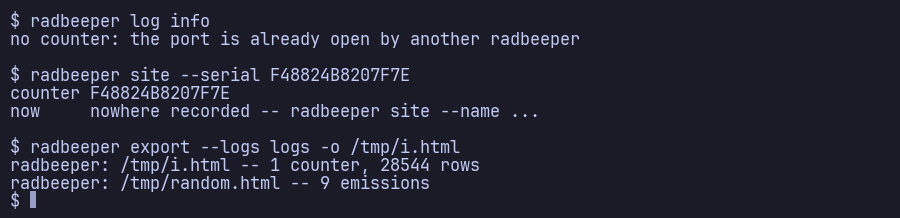
A reading without a place is half a measurement, and these get carried about — so the place is a property of a serial number over time, appended to sites.tsv and never overwritten. A reading from last Tuesday resolves to where the counter was last Tuesday.
It records a name and nothing finer, on purpose. These logs get published; a place name is what a reader needs, while a decimal fix is a street address for whoever is holding the counter. Nothing is assumed either: until you record a place, the column is empty.
Further reading
- The stream — how several counters become one record, and why the interleave is the fact no per-counter file can hold.
- The cascade strip — the counts strip the log rows tick under.
- Reference — the tube factor, the protocol, the tests.
MIT License — Copyright (c) 2026 Paul Richeson