The counters and the dials
↑ Reading the window · The big number and the five averages →
The top of the window: one line per counter, and one dial each.
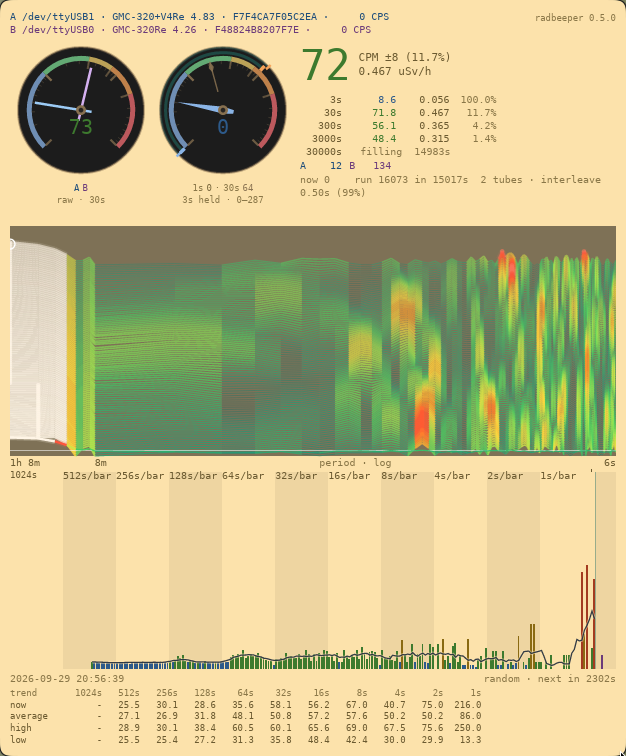
The counters
One line per counter: its port, its model and firmware, its serial, and what it counted in the last second. An empty space where the count should be means that counter has stopped answering. A counter that is not answering is left out of every average, so a figure is never made from a stale reading. It is the instrument saying it is not measuring, rather than claiming to.
The dials
Two dials, needles on a fixed logarithmic scale with a 270-degree sweep, the reading in digits on the face. The coloured bands on the faces are the same thresholds everything else on the window uses, in counts per minute:
| Band | From |
|---|---|
| nominal | 30 CPM |
| advisory | 120 CPM |
| warning | 240 CPM |
| deadly | 600 CPM |
Below 30 CPM the reading is attenuated: less than an ordinary room, which usually means the tube is shielded or has stopped.
The left dial is raw. One needle per counter, in that counter's colour, at its own 30-second rate; the letters under the face say which counters are on it, and the digits read their mean. Captioned raw · 30s.
The right dial is the live one. Its needle sits at the last three seconds, the shortest window the panel keeps: one second of one tube is two or three arrivals and mostly noise, and three seconds is enough to read a value off while still showing a source passing under the tube. The chrome pointer behind it marks the 30-second figure, and the two arcs outside the bands show the lowest and highest the needle has been in that half minute. Its caption says all three: 3s held · 8–78 is the needle's window and the range, and the line above it, 1s 0 · 30s 33, is this second's count and the half-minute rate the pointer is at.
↑ Reading the window · The big number and the five averages →